 Do you have early signs of aging on your face that you would like to reverse but worry that it may be too soon to have facelift? You may be a great candidate for mini facelift, a less invasive alternative to traditional facelift. Renowned facial plastic and reconstructive surgeon Dr. Jonathan Grant can make small adjustments to the underlying tissue to restore definition to your jawline and take several years off your appearance.
Benefits of Mini Facelift
Mini facelift manipulates the tissue and muscle at the bottom of the face to create a lifting effect. It is successful at reducing mild to moderate skin sagging (jowls) and smoothing out mild lines and wrinkles. Many patients also enjoy the shorter recovery period, lower price, and natural-looking results.
What Distinguishes Mini Facelift from Full Facelift
The term “mini” refers to minimal incision. With this approach, Dr. Grant usually uses just two small incisions to rejuvenate the lower face, leaving even tinier and less visible scars. Most traditional facelift surgeries tackle aging on the lower face and neck simultaneously, whereas mini lift only addresses aging on the lower face.
Candidates for Mini Facelift
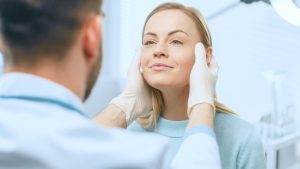 The best candidates for mini facelift have developed early signs of aging on their face, especially jowls. You should be in good health overall, a non-smoker, and set reasonable expectations about what a less invasive surgery can achieve.
Patients who have developed more advanced signs of aging like deeper set lines or aging on the neck may be better candidates for full facelift. Ignoring signs of aging on the neck while rejuvenating the lower face can produce unnatural-looking results. All your rejuvenation options will be discussed during a consultation with Dr. Grant.
Mini Facelift Procedure
Due to the less invasive nature, Dr. Grant can usually perform mini facelift with local anesthesia rather than general anesthesia. This is an outpatient procedure, meaning that you return home to recover on the same day as your surgery.
Dr. Grant places incisions behind the ears and carefully lifts tissues and skin upwards to create a tauter appearance with minimized jowls. His advanced techniques allow him to achieve youthful looking facial contours without having to remove much skin and tissue, which helps patients to maintain a natural-looking appearance.
Mini Facelift Recovery and Results
 The recovery for mini facelift is significantly shorter than for other facial plastic surgery patients. Prescribed pain medication is sufficient to relieve lingering discomfort. Most patients feel well enough to return to work within a week or two. Dr. Grant will schedule follow-up appointments to ensure you are healing well.
The results for mini facelift last several years, but it cannot stop the aging process altogether. Eventually, a decline in collagen and elastin production will cause skin laxity (along with wrinkles and jowls) to reappear. Later, you may decide to have a full facelift to address more significant signs of aging.
Exploring Mini Facelift vs. Other Options
Facial rejuvenation is not one-size-fits-all. A mini facelift addresses early sagging along the jawline by tightening and supporting the underlying facial structures and removing excess skin. It is a surgical solution designed for patients who want visible structural improvement without undergoing a full facelift.
A traditional facelift treats more advanced aging in the midface and jawline, and often encompasses the neck. It allows for more extensive lifting and contouring when skin laxity and tissue descent are more pronounced. Patients with significant jowling, deeper folds, or neck banding may benefit more from a full facelift. A mini facelift, in contrast, focuses on earlier changes and delivers refined improvement in a more targeted area.
Non-surgical options also play an important role. Injectable fillers restore volume that has diminished over time, softening folds and enhancing facial contours. Neuromodulators such as Botox® relax dynamic wrinkles caused by muscle movement. These treatments can refresh your appearance without surgery, and they remain excellent options for patients seeking subtle enhancement. It is important to recognize that Botox® and fillers are temporary and require maintenance treatments to sustain results.
Fractionated laser skin resurfacing improves skin tone, texture, and fine lines by stimulating collagen production and resurfacing damaged skin. Both ablative and non-ablative laser treatments can enhance skin quality and complement surgical procedures. However, laser resurfacing does not reposition sagging tissues. It improves the skin’s surface rather than lifting deeper structures.
Many patients combine treatments strategically. A mini facelift may restore jawline definition, while fillers refine volume, and laser resurfacing improves skin texture. During your consultation, Dr. Grant evaluates your anatomy, skin quality, and goals to recommend the approach that works best for your goals. Each option has value for the right patient, and the ideal choice depends on the degree of aging present and the level of correction you want to achieve.
Why Choose Dr. Jonathan Grant For Your Mini Facelift
Dr. Jonathan R. Grant is a board-certified, fellowship-trained facial plastic and reconstructive surgeon dedicated exclusively to the face and neck. His focused expertise allows him to approach every procedure with a deep understanding of facial anatomy, balance, and function. In addition to cosmetic surgery, he performs complex reconstructive procedures, including skin cancer reconstruction and treatment of facial injuries and scars. This breadth of experience strengthens his precision and attention to detail.
Dr. Grant provides both medical and surgical care, offering advanced facial plastic surgery techniques, ablative and non-ablative laser treatments, and face and neck liposculpture. His comprehensive skill set allows him to design individualized treatment plans that address both structure and skin quality.
His recent accolades reflect his commitment to excellence. He received the American Institute of Plastic Surgeons Patient Satisfaction Award, recognition from Seattle City Voter A-List as a Top 10 Plastic Surgeon, and distinction from the Consumers’ Research Council of America as a Top Physician. Patients in the Seattle area and beyond seek Dr. Grant for his technical expertise, thoughtful consultation process, and dedication to natural-looking results that preserve facial character while restoring confidence.
Schedule a Consultation
To discover why Dr. Grant is such a popular choice for facial rejuvenation patients in Mt. Vernon and Seattle, Washington, please schedule a consultation. Call (360) 336-1947 to determine if mini facelift is the optimal way to restore definition to your jawline.
Mini Facelift FAQs
What is a mini facelift and how is it different than a facelift?
A mini facelift is a less invasive surgery to reduce signs of lower-face aging. A traditional facelift treats the full face and neck, while a mini facelift primarily targets the lower one-third of the face.
The procedure uses smaller incisions, typically resulting in quicker recovery and a more subtle, natural look.
Who is a good candidate for a mini facelift?
Ideal mini facelift candidates are in good health and typically in their late 30s to 50s. However, it could also be right for some older patients with minimal signs of aging.
The procedure is generally well suited to patients who notice early facial aging, particularly sagging jowls.
Because a mini facelift is more about subtle rejuvenation, it’s important to have realistic expectations.
What areas of the face are addressed with a mini facelift?
A mini facelift treats the lower face: The jawline, cheeks, and the areas around the mouth and chin. It helps tighten the skin, reduce sagging, and rejuvenate the lower part of the face for a more youthful appearance.
How long does a mini facelift procedure take?
Depending on your unique needs, a mini facelift may take less than a couple of hours. It’s quicker than a traditional facelift, which can last up to twice as long.
What is the recovery time for a mini facelift?
Recovery time is generally shorter for a mini facelift than a traditional one. Most patients can return to light activities within one or two weeks. Swelling and bruising gradually improve over the following weeks, and full recovery (and final results) may take a few months.
How long do the results of a mini facelift typically last?
While the procedure effectively tightens and rejuvenates the skin, the natural aging process will continue. However, results usually last up to a decade.
This can vary based on lifestyle, skin condition, and overall health. A well-maintained skincare routine and a healthy lifestyle can help prolong your results.
What are the risks or complications associated with a mini facelift?
Risks like infection, bleeding, and scarring are present with any surgical procedure. However, as a highly experienced plastic surgeon, Dr. Grant takes every precaution to minimize these risks.
Complications are rare, but temporary numbness, swelling, or bruising is common. This usually goes away in a few weeks.
What kind of anesthesia is used during a mini facelift?
Because it’s a less invasive procedure, Dr. Grant usually performs the procedure using local anesthesia with sedation. You’ll be awake but fully relaxed and not experience pain during the procedure.
How much does a mini facelift typically cost?
Mini facelift costs depend on the corrections you need and your unique situation. The cost typically includes the surgeon’s, anesthesia, and facility fees. A mini facelift is less expensive than a full facelift.
Will a mini facelift get rid of deep wrinkles?
A mini facelift is best for moderate sagging and improved lower facial contours but is not generally suited for deep wrinkles. A full facelift is better for major lines and folds.
Can I combine a mini facelift with other procedures?
Yes, many patients combine a mini facelift with other surgeries, such as eyelid surgery, brow lifts, or injectables like dermal fillers, to enhance the overall rejuvenation of the face. Combining treatments can provide more comprehensive results.
Will I have visible scars after a mini facelift?
Scarring is minimal after a mini facelift, as Dr. Grant expertly positions the small incisions in discreet locations around the ears and hairline. Over time, scars typically fade and become nearly invisible.
How do I prepare for a mini facelift procedure?
Preparation starts with a thorough consultation with Dr. Grant. He typically recommends avoiding smoking and certain medications before surgery, and you may need to discontinue blood thinners temporarily.
How long before I see the final results of a mini facelift?
Most patients notice initial improvements in the first few weeks, but the final results typically take a few months to develop fully. Swelling subsides, and the tissues settle into place over time, leaving you with a naturally rejuvenated appearance.
If you’re ready to take the next step in rejuvenating your appearance, call us at 310-385-8601 in Beverly Hills to book your consultation today.